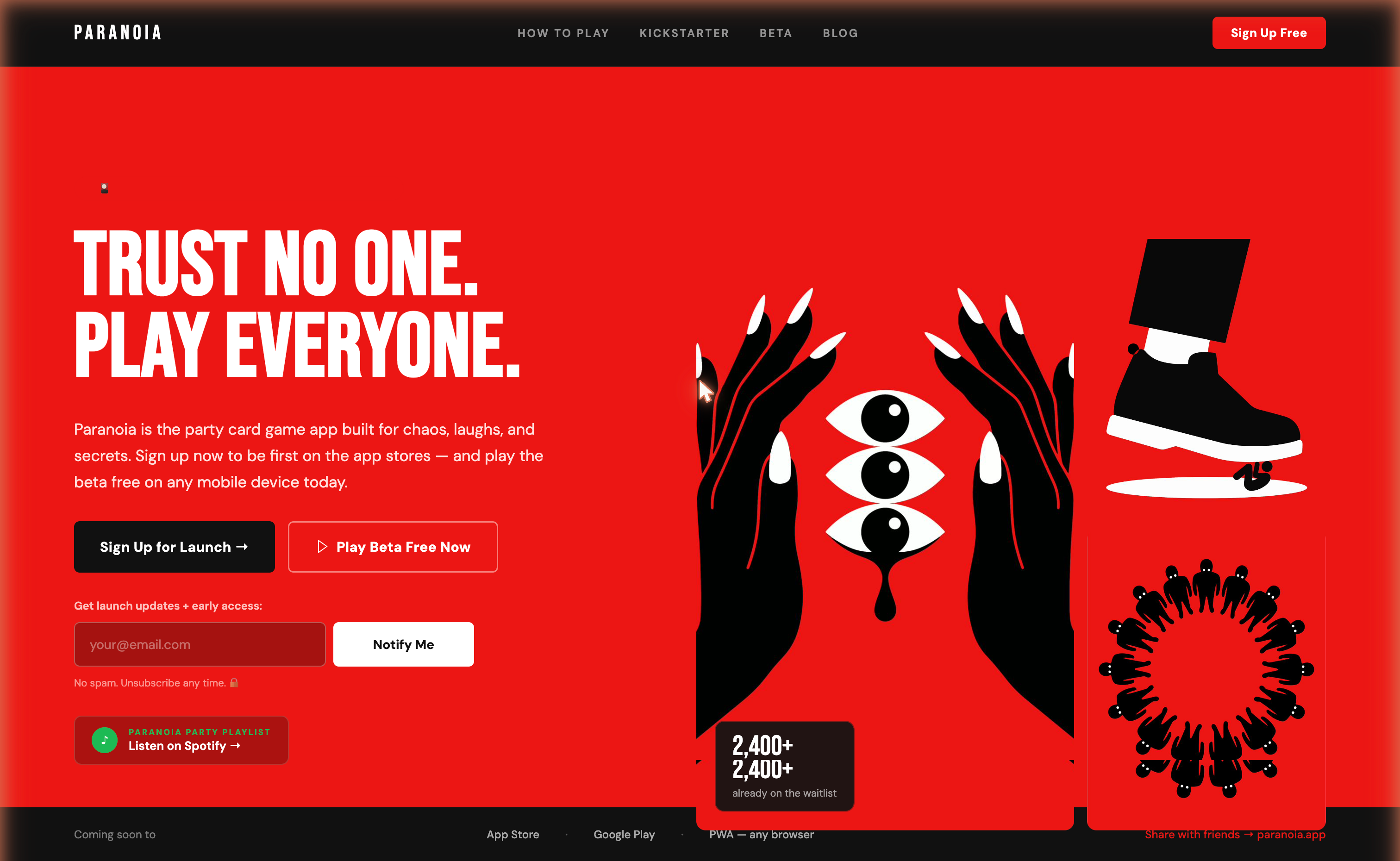
Paranoia is a Gen Z and Millennial party card game — reimagined as a mobile app built for chaos, laughs, and secrets. The brief was a launch problem, not just a design one: take a chaotic, social, hard-to-explain concept and turn it into something people would sign up for before it even hit the app stores. My role was product and UX strategy — shaping how the game is positioned, how the funnel converts curiosity into commitment, and how the free beta turns players into a launch audience.
Party games live or die on word of mouth, and “trust no one” is a feeling, not a feature list. The launch site had to do three things at once: explain an unconventional social game in seconds, build enough credibility for a pre-launch product with no track record, and give two different audiences — Kickstarter backers and beta players — a clear, frictionless next step. Most pre-launch pages try to do everything and convert no one.
I worked back from a single launch metric: waitlist sign-ups. That meant leading with the emotional hook — Trust No One. Play Everyone. — instead of mechanics, and sequencing the page so curiosity comes first and the ask comes second. The funnel was deliberately split: a low-commitment “Play the beta free” path for people who want proof, and a “Notify me” capture for people ready to commit. Supporting touches — a Spotify party playlist, social proof, and a Kickstarter pre-register prompt — were placed to remove hesitation at each decision point rather than pile on features.
A focused, conversion-first launch experience: an emotionally-led hero that sells the feeling of the game in under three seconds, a frictionless waitlist capture, and a free mobile beta that doubles as the strongest possible proof. Every section maps to one job — hook, prove, convert — with no dead ends and one obvious action at a time. The result reads less like a brochure and more like an invitation.
The launch funnel converted early interest into a 2,400+ player waitlist ahead of the Kickstarter and app-store release — a real, engaged pre-launch audience for a product with no prior footprint. By splitting the funnel between a free beta and a notify-me capture, Paranoia turned curious visitors into committed players and gave the team a warm audience to launch into rather than a cold start.